Tag

what is series

Trade Ninja Blog

Trade Ninja’s Sports Trading & Betting Blog is home to all the latest news and developments about the Trade Ninja service.

If you are looking for a particular post then just hit the magnifying glass and search away

Asian Handicaps – EXPLAINED

By | Explained Series | No Comments

Asian Handicap Betting EXPLAINED!

What is Asian Handicap

Asian Handicap removes the possibility of a draw and gives one team a “head start” or “handicap” so the bet becomes more balanced.

That’s it. Everything else is just variations of how big that head start is.

Why It Exists?

In football, favourites win more often. Bookmakers use Asian Handicap to:

  • Make mismatched games more interesting
  • Give you fairer odds
  • Remove the draw (so only two outcomes exist)

The Core Idea

The core idea

You’re not betting on the match result. You’re betting on the result after the handicap is applied.

Think of it like this:

One team starts the match with imaginary goals added or removed.

Handicap Levels Explained

Below is the simplest possible breakdown of every type.

1️⃣ Whole‑goal handicaps (−1, +1, −2, +2)

Example: Team A −1

Team A starts the match minus one goal.

  • If they win by 2+ goals → your bet wins
  • If they win by exactly 1 goal → refund (called a “push”)
  • If they draw or lose → your bet loses

Example: Team B +1

Team B starts plus one goal.

  • If they win or draw → win
  • If they lose by exactly 1 → refund
  • If they lose by 2+ → lose


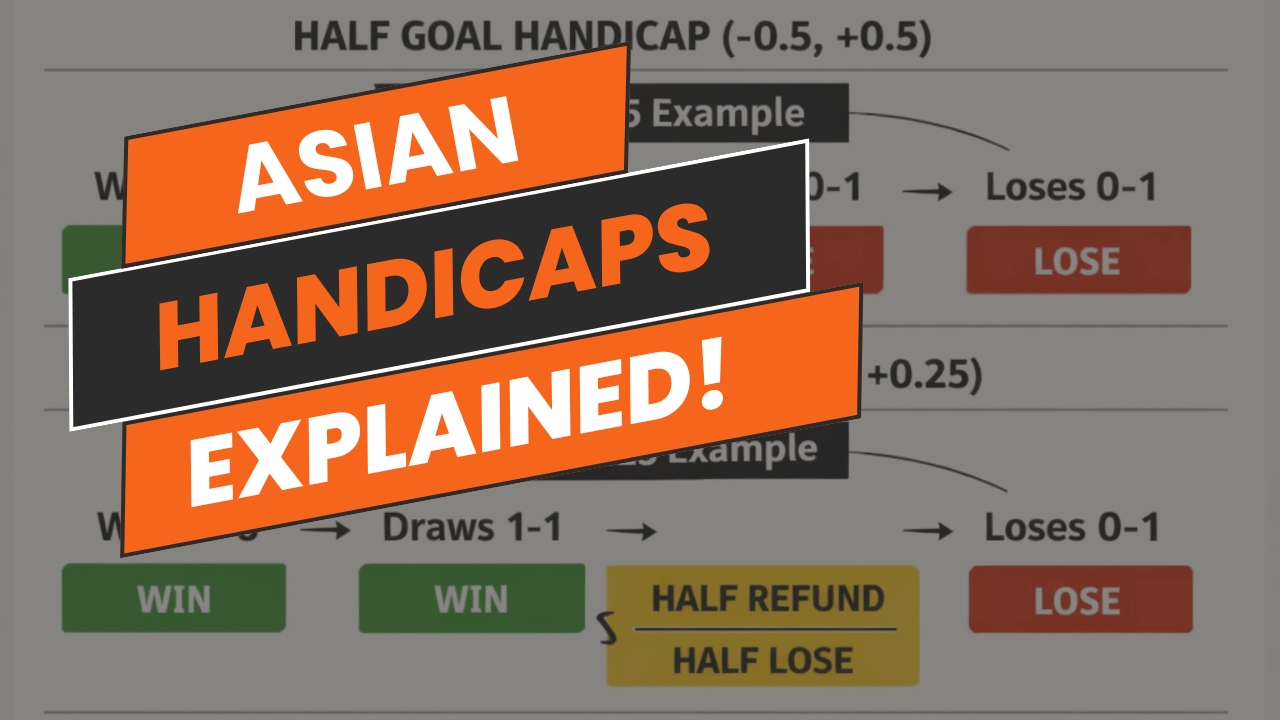
2️⃣ Half‑goal handicaps (−0.5, +0.5, −1.5, +1.5)

These cannot end in a draw → no refunds.

Example: Team A −0.5

Team A must win the match. Anything else = loss.

Example: Team B +1.5

Team B can:

  • Win
  • Draw
  • Lose by 1 goal All of these = win.

Lose by 2+ = loss.

3️⃣ Quarter‑goal handicaps (−0.25, +0.25, −0.75, +0.75)

This is where people get confused — but it’s actually simple.

A quarter handicap is just two bets in one.

Example: Team A −0.25

This is the same as betting:

  • Half your stake on Team A 0
  • Half your stake on Team A −0.5

So:

  • If Team A wins → full win
  • If Team A draws → half refund, half loss
  • If Team A loses → full loss

Example: Team B +0.75

This is the same as:

  • Half your stake on +0.5
  • Half on +1.0

So:

  • Win or draw → full win
  • Lose by 1 → half loss, half refund
  • Lose by 2+ → full loss

Simple Cheat Sheet

Handicap

What it means

What you need

0

No handicap

Your team must win (draw = refund)

−0.5

Your team starts half a goal behind

Must win

+0.5

Your team starts half a goal ahead

Win or draw

−1

Your team starts 1 goal behind

Win by 2+ (1 = refund)

+1

Your team starts 1 goal ahead

Win/draw (lose by 1 = refund)

−0.25

Split: 0 and −0.5

Win = win, draw = half loss

+0.25

Split: 0 and +0.5

Win/draw = win, draw = half win

−0.75

Split: −0.5 and −1

Win by 2+ = win, win by 1 = half win

+0.75

Split: +0.5 and +1

Win/draw = win, lose by 1 = half loss

Imagine you’re giving a weaker team a head start or making a stronger team prove their dominance.

That’s all Asian Handicap is.

Asian Handicap Infographic

Share on facebook
Facebook
Share on twitter
Twitter
Share on linkedin
LinkedIn
Share on google
Google+

Why ‘No Lay’ Matched Betting Offers a Superior Long-Term Return

By | Explained Series | No Comments

Why 'No Lay' Matched Betting Offers a Superior Long-Term Return

Why 'No Lay' Matched Betting Offers a Superior Long-Term Return

Matched betting has become a popular method for exploiting bookmaker offers to generate predictable profit. The conventional wisdom involves “backing” an outcome with a bookmaker and “laying” it (betting against it) on an exchange to cancel out risk, locking in a small profit from free bets. However, for the experienced and strategic bettor, the safety net of laying every bet often comes at a steep cost: lost value.
The true long-term edge lies in mastering the “no lay” approach, particularly concerning free bets and each-way (EW) promotions, where the act of laying actively drains the inherent value.

The Problem with Laying: Commission and Market Inefficiency

The core issue with laying is twofold: exchange commission and the efficiency of the lay market.

  1. 1.  The Commission Cost: Betting exchanges, such as Betfair and Smarkets, charge a commission, typically between 2% and 5%, on winning lay bets. This is a constant drag on profitability. When you lay a free bet, you are securing a guaranteed profit, but you are also sacrificing a portion of that profit to the exchange, resulting in a 1.5% to 5% reduction in your Expected Value (EV).  The main MB sites do combat this by offering 0% commission for certain exchanges.  The results posted however are to 0% commission so if you are paying any commission the disparity to the results here are even greater

    2. Inefficient Value Extraction: When you lay a free bet, you are essentially selling the bookmaker’s value back to the exchange. If the lay odds aren’t perfectly aligned with the true probability, you are sacrificing valuable EV to guarantee a cash-out. By letting the free bet run with ‘No Lay,’ you preserve the full, untaxed Expected Value of the offer.
    In matched betting, we seek to exploit the positive EV offered by bookmakers. Introducing the lay market, and its associated costs, only serves to dilute that edge.

The Each-Way Trap: Laying the Place Part

The argument for the no-lay approach becomes especially compelling when considering Each-Way (EW) betting promotions like “Extra Places” in horse racing.

• The Flawed Place Price: Bookmakers’ place odds are formulaic (a fraction of the win odds). This calculation often results in place odds that are higher than the horse’s true probability of placing—the very source of positive EV.

• Lay Odds Drain the Edge: When you lay the place part on the exchange, you are almost always accepting lay odds that are more accurate or carry a commission hit. This lay bet aggressively removes the value you are trying to exploit.
Many advanced bettors will lay the win part to hedge against a massive win, but they will run the place part as ‘no lay’ to capture the maximum value from the mispriced odds.

Bankroll Efficiency: Unlocking Volume with 'No Lay'

While maximising profit (EV) is key, a major practical benefit of the ‘No Lay’ strategy is the vastly reduced bankroll requirement needed to operate at high volume.
In traditional matched betting, every back bet requires a large amount of capital on the exchange to cover the potential liability—often 5x to 10x your stake. This limits your activity, forcing you to wait for funds to clear before placing the next bet.
The ‘No Lay’ approach removes this financial constraint:
• Zero Exchange Liability: You eliminate the need to hold capital on the exchange.
• Capital Velocity: This freed-up capital can be immediately re-invested into more bookmaker bets, promotions, and value opportunities.
• Accessibility: You can place significantly more bets in a shorter period with a much smaller starting bankroll, accelerating your journey toward higher profits.
‘No Lay’ betting doesn’t just increase your profit percentage; it increases your betting volume potential, turning your available capital over more efficiently.

The Proof is in the Profit: Real-World Results of No Lay vs. Lay

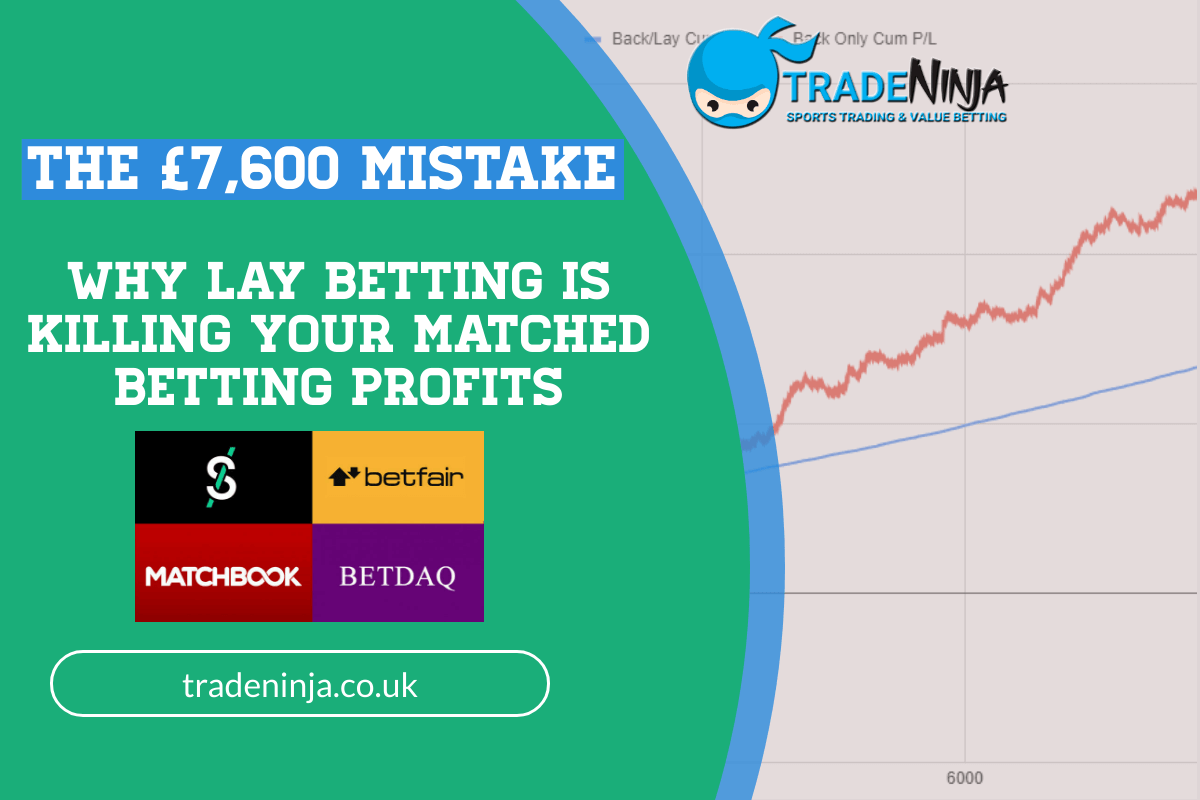
The theoretical arguments are powerfully reinforced by real-world data. Our results, spanning over 9,000 matched bets, provide undeniable proof of the ‘No Lay’ advantage.
The Financial Evidence: £7,900 vs. £15,500
Meticulously tracking the outcomes of promotions and value bets reveals a massive disparity:

Strategy

No. of Bets

Total Profit
Generated

Percentage
Increase

Traditional
Back/Lay

9,000+

£7,900

N/A

Value ‘No Lay’

9,000+

£15,500+

+96.2%

This comparison reveals a near 100% increase in profitability over a substantial sample size. Over the course of 9,000+ bets, the act of laying effectively halved the total potential profit.

The £7,600 difference between the Lay and No Lay results represents the total Expected Value that was surrendered to the exchange to guarantee a profit and smooth out short-term variance.

Embracing Volatility for Superior Returns

A lay bet is essentially an insurance policy against a losing streak. However, once you have a sufficient bankroll and a strong understanding of Expected Value, you must ask: Am I willing to pay a premium (commission and inefficiency) just to smooth out my results?

The ‘No Lay’ approach requires a higher tolerance for variance. You will experience more losing streaks than if you laid every bet. But in the long run, because you are consistently taking the full positive EV on offer, your total profit will be significantly higher, as proven by the data.

Ready to Ditch the Lay and Embrace the Value? Meet Value Ninjas

You’ve seen the data: letting value run via a ‘No Lay’ approach is the key to unlocking maximum long-term profit. But consistently finding those genuine value spots and boosts across all major bookmakers, seven days a week, is a challenge. That’s where we step in.

Stop Searching, Start Earning with Value Ninjas

Value Ninjas is your dedicated service for identifying and delivering positive Expected Value betting opportunities. We do the heavy lifting, scanning all main UK online bookmakers and major sports markets to find the most profitable value bets and price boosts for you.

Since our launch in 2023, we’ve focused exclusively on profitable value and strategic advantage, and we’re about to celebrate our two-year anniversary with an impeccable record:

• Zero Losing Months: We have delivered consistent profit every single month since launch.
• Over 20,000 Value Bets: We provide a consistent stream of opportunities daily.
• £28,000+ Profit to £10 Stakes: Our members have seen phenomenal returns, proving the power of a long-term, high-volume value strategy.

We are a Value Betting Service dedicated to exploiting bookmaker errors and profitable promotions using the high-EV, No Lay method you’ve just read about.

Special Offer: Maximize Your November Profits

Ready to put the ‘No Lay’ strategy to the test with proven value picks? To celebrate the power of value over laying, we are offering you a chance to join the winning team:
Use code NOLAY during November to get 50% off your first month of Value Ninjas!
Stop paying exchange commission and start capturing the full value of every promotion. Join the Ninjas today and accelerate your profits.

Share on facebook
Facebook
Share on twitter
Twitter
Share on linkedin
LinkedIn
Share on google
Google+

Betting Exchanges Explained

By | Explained Series | No Comments

BETTING EXCHANGES EXPLAINED

Part of Trade Ninja "EXPLAINED" series!

Trade Ninja “EXPLAINED” series aim to help explain some popular Betting / Trading terms/areas.

Betting Exchanges

Betting exchange sites are online platforms that allow users to bet against each other instead of against a bookmaker or the house. Here’s how they typically work:

  1. Users sign up for an account on the betting exchange site and deposit funds into their account.
  2.  
  3. Users can then browse the available markets and odds, which are determined by other users placing bets.
  4.  
  5. Users can place two types of bets on a betting exchange site: “back” bets and “lay” bets.
  6.  
  7. A “back” bet is a traditional bet, where a user bets on a particular outcome to happen. For example, if you bet on a football team to win, you are placing a back bet.
  8.  
  9. A “lay” bet is the opposite of a back bet, where a user bets against a particular outcome happening. For example, if you bet against a football team to win, you are placing a lay bet.
  1. When a user places a bet, it is matched with another user’s opposing bet. For example, if one user places a back bet on a football team to win, another user must place a lay bet against that team to match the bet.
  2.  
  3. The betting exchange site takes a commission on the winnings of the winning user, which is typically a small percentage of the total winnings.
  1. Users can also trade bets on the betting exchange site, by buying and selling bets before the event has finished.
  2.  

Betting exchange sites offer users more control over their bets, as they can set their own odds and bet against other users. However, users also take on more risk as they are betting against other users, rather than a bookmaker who takes on the risk.

Current UK Betting Exchanges

BetConnect

BetDaq

BetFair

Matchbook

Smarkets

Share on facebook
Facebook
Share on twitter
Twitter
Share on linkedin
LinkedIn
Share on google
Google+

Back & Lay Betting Explained

By | Explained Series | No Comments

BACK & LAY BETTING EXPLAINED

Part of Trade Ninja "EXPLAINED" series!

Trade Ninja “EXPLAINED” series aim to help explain some popular Betting / Trading terms/areas.

Back & Lay Betting

Back and Lay betting are two different types of betting commonly used in betting exchanges, where punters bet against each other rather than against the bookmaker.

Back betting is the traditional form of betting where a punter bets on a particular outcome to occur. For example, if you back a horse to win a race, you are betting that the horse will come first. If your bet is successful, you win your stake multiplied by the odds of the selection.

Lay betting, on the other hand, is the opposite of back betting. It involves betting against a particular outcome to occur. For example, if you lay a horse to win a race, you are betting that the horse will not come first. If your bet is successful, you win the stake of the person who backed the selection.

In a betting exchange, there are two types of customers: backers and layers. Backers are customers who want to back a particular outcome to occur, while layers are customers who want to lay a particular outcome.

For example, if a backer wants to place a bet on a horse to win a race, the exchange will match the bet with a layer who is willing to lay the same bet. The exchange acts as an intermediary between the two customers, taking a commission on the winnings.

Back and Lay betting allows customers to take on the role of a bookmaker, setting odds and accepting bets from other customers. This provides customers with greater flexibility and control over their betting, allowing them to profit from both winning and losing selections.

Back and Lay betting are two common types of betting that you can use when placing a bet on a sports event or a horse race.

Back Betting

When you place a back bet, you are betting on something to happen, just like a traditional bet. For example, if you think a football team will win a match, you can place a back bet on that team to win. If the team wins, you will win your bet, and if they lose or draw, you will lose your bet.

Example:

Let’s say you want to bet on a tennis match between Roger Federer and Rafael Nadal. If you believe that Nadal will win, you can place a back bet on Nadal to win. If Nadal wins, you will win your bet, and if Federer wins, you will lose your bet.

Lay Betting

Lay betting is the opposite of back betting. Instead of betting on something to happen, you are betting on something not to happen. In other words, you are acting like a bookmaker and accepting bets from other people. If the outcome that you bet against does not happen, you win your bet, and if it does happen, you lose your bet.

Example:

Continuing with the same example, if you believe that Federer will not win the tennis match, you can place a lay bet on Federer not to win. If Federer loses or draws, you will win your bet, and if he wins, you will lose your bet.

Summary

In summary, back betting involves betting on something to happen, while lay betting involves betting on something not to happen. Both types of betting have their own risks and rewards, and it’s up to you to decide which one to use based on your knowledge and confidence in the outcome.

Share on facebook
Facebook
Share on twitter
Twitter
Share on linkedin
LinkedIn
Share on google
Google+

Exchange Commissions Explained

By | Explained Series | No Comments

BETTING EXCHANGE COMMISSIONS EXPLAINED

Part of Trade Ninja "EXPLAINED" series!

Trade Ninja “EXPLAINED” series aim to help explain some popular Betting / Trading terms/areas.

Betting Exchange Commissions

Betting exchanges are online platforms that allow users to bet against each other on the outcome of sporting events, political events, and other events. Unlike traditional bookmakers, where users bet against the bookmaker’s odds, at a betting exchange, users set their own odds and bet against other users.

One of the ways that betting exchanges generate revenue is through commissions. A commission is a percentage of the user’s winnings that the exchange charges as a fee for using the platform.

The commission rate varies between betting exchanges and is typically between 2% and 5% of the user’s winnings. For example, if a user wins £100 on a betting exchange with a 5% commission rate, they will be charged £5 in commission.

It’s important to note that the commission is only charged on the net winnings of a bet. So, if a user bets £100 on a selection and the return is £200, the commission would only be charged on the £100 net winnings, not on the entire £200 payout.

Some betting exchanges offer a tiered commission structure, where users who bet larger amounts or more frequently can qualify for lower commission rates. Additionally, some exchanges may offer promotions or bonuses that waive or reduce the commission for a certain period or for certain users.

Overall, commissions are an essential part of a betting exchange’s revenue model, and users should factor them into their betting strategy when deciding which exchange to use and how much to bet.

Current Exchange Commission Rates

BetConnect = 0% On All Lay Bets*

BetDaq = 2%*

Betfair = 2% upto 7% depending on Rewards Plan

Matchbook = 2%*

Smarkets = 2%*

Get 0% Commission*

If you are into Matched Betting then you are currently able to receive 0% commissions from multiple exchanges.  One of the leading Matched Betting service providers OddsMonkey are currently offering their members 0% commission on 4 exchanges – Smarkets, Matchbook, BetDaq & Bet Connect.

OddsMonkey are also the only current Matched Betting service provider to include odds from all of the above exchanges in their tools!!

Checkout our OddsMonkey review here and get in on the 0% while it is available!

Share on facebook
Facebook
Share on twitter
Twitter
Share on linkedin
LinkedIn
Share on google
Google+

Value Betting Explained

By | Explained Series | No Comments

VALUE BETTING EXPLAINED

Part of Trade Ninja "EXPLAINED" series!

Trade Ninja “EXPLAINED” series aim to help explain some popular Betting / Trading terms/areas.

Understanding Value Betting?

Sports betting has evolved from a mere pastime to a realm of strategic opportunities for avid bettors. While luck can play a role, seasoned gamblers understand that finding value in betting markets is the key to long-term success. In this article, we delve into the concept of value betting, exploring its intricacies, strategies, and how it can empower you to make informed decisions that lead to profitable outcomes.

Value betting revolves around the notion of identifying odds that are higher (or lower) than they should be, based on the true probability of an event occurring. In other words, it’s all about spotting opportunities where the bookmakers’ estimations diverge from your own analysis of the situation. By finding value bets, you gain an edge over the bookmakers and pave the way for consistent profits.

To grasp value betting, it’s crucial to understand the concept of expected value (EV). EV represents the average amount of money you would expect to win (or lose) if you placed the same bet repeatedly. A positive EV bet implies that, over the long run, you should make a profit, while a negative EV bet suggests you are likely to lose money.

Calculating Expected Value

The formula for calculating EV is relatively straightforward: Expected Value = (Probability of Winning * Potential Profit) – (Probability of Losing * Potential Loss). By estimating the true probability of an outcome and comparing it to the odds provided by bookmakers, you can assess whether a bet holds value or not.

Research and Analysis: Informed decision-making is the foundation of value betting. Thoroughly research the teams, players, and factors that can influence the outcome of an event. Analyze statistics, study recent form, assess team news, and consider historical data to develop a comprehensive understanding.

Identify Market Inefficiencies: Bookmakers may have biases or overlook certain factors, which can create opportunities for value betting. Look for events where public opinion, recent performance, or media hype has skewed the odds, potentially leaving room for you to capitalize on discrepancies.

Compare Odds: Comparing odds across multiple bookmakers is essential in value betting. Each bookmaker may have a slightly different estimation, so by identifying the best odds available, you increase your chances of finding value bets. Utilize odds comparison websites or specialized software to streamline the process.

Bankroll Management: Successful value betting requires discipline and effective bankroll management. Allocate a specific portion of your bankroll to value bets and avoid impulsive decisions or chasing losses. A long-term perspective is crucial to weather the ups and downs of value betting.

Summary

Value betting offers a strategic approach to sports wagering, empowering bettors to find profitable opportunities in a market often clouded by chance. By understanding the concept of value, conducting thorough research, and leveraging technology, you can gain an edge over bookmakers and make well-informed decisions.

Remember, value betting is a long-term game, and discipline, patience, and effective bankroll management are key to realizing consistent profits.

Embrace the value betting mindset, and unlock the potential for success in the world of sports wagering.

If you are interested in Value Betting then we would encourage you to check out our sister site Value Ninjas who provide a great Value Betting service, click here to find out more

Share on facebook
Facebook
Share on twitter
Twitter
Share on linkedin
LinkedIn
Share on google
Google+

Arbitrage Sports Betting Explained

By | Explained Series | No Comments

ARBITRAGE BETTING EXPLAINED

Part of Trade Ninja "EXPLAINED" series!

Trade Ninja “EXPLAINED” series aim to help explain some popular Betting / Trading terms/areas.

What Is Arbitrage Betting?

Arbitrage betting, also known as “arbing” or “Sure Betting” is a technique used in sports betting where a bettor takes advantage of discrepancies in the odds offered by different bookmakers for the same event.

In arbitrage betting, a bettor places bets on all possible outcomes of a sporting event using different bookmakers. The goal is to find a combination of bets that guarantees a profit, regardless of the outcome of the event.

This is possible because different bookmakers often have slightly different odds for the same event, and a skilled bettor can exploit these differences to their advantage.

For example, suppose that one bookmaker offers odds of 2.0 on a team to win a game, while another bookmaker offers odds of 2.1 on the opposing team to win. A bettor could place a bet on both teams, so that no matter who wins, they will make a profit. Specifically, if the bettor bets $100 on the first team and $91.50 on the second team (using the odds given), then they will be guaranteed a profit of $8.50, regardless of the outcome of the game.

It’s worth noting that arbitrage betting requires careful calculation and a keen eye for spotting differences in odds between bookmakers. Additionally, bookmakers are aware of arbitrage betting and may limit the amount a bettor can wager or close their account if they suspect they are using this strategy.

How Do I Find Arbitrage Bets?

Finding arbitrage bets requires comparing the odds offered by different bookmakers for the same event and identifying situations where the combined odds create an opportunity for arbitrage. Here are some steps to help you find arbitrage bets:

  1. Identify reliable bookmakers: Start by researching and identifying reputable bookmakers with a history of competitive odds. This will provide you with a pool of bookmakers to compare.

  2. Select an event: Choose a sporting event that has multiple bookmakers offering odds. It’s often easier to find arbitrage opportunities in popular sports like football, basketball, or tennis.

  3. Compare odds: Visit multiple bookmakers and compare the odds for all possible outcomes of the event. Look for significant discrepancies in the odds offered by different bookmakers.

  4. Calculate implied probabilities: Convert the odds into implied probabilities using a probability calculator or formula. Implied probability represents the bookmaker’s assessment of the likelihood of an outcome occurring.

  5. Assess total probability: Sum up the implied probabilities for each outcome. If the total is less than 100%, an arbitrage opportunity may exist.

  6. Identify potential arbitrage: Look for situations where the total implied probability is less than 100%. This indicates that by strategically placing bets on all possible outcomes, you could guarantee a profit.

  7. Calculate bet sizes: Use an arbitrage calculator to determine the appropriate bet sizes for each outcome to ensure a profit, regardless of the result.

  8. Act quickly: Arbitrage opportunities can be short-lived as bookmakers may adjust their odds to eliminate discrepancies. Therefore, it’s crucial to act swiftly to place your bets before the odds change.

Remember, finding arbitrage bets requires careful monitoring of odds across different bookmakers, and it can be time-consuming. 

There are services available that can help and provide Arbitrage opportunities, an example being Rebel Betting, checkout our Rebel Betting Review here and get a 14 day FREE TRIAL!!

Share on facebook
Facebook
Share on twitter
Twitter
Share on linkedin
LinkedIn
Share on google
Google+

Odds Boosts Explained

By | Explained Series | No Comments

ODDS BOOSTS EXPLAINED

Part of Trade Ninja "EXPLAINED" series!

Trade Ninja “EXPLAINED” series aim to help explain some popular Betting / Trading terms/areas.

What Are ODDS BOOSTS?

Odds boosts, also known as enhanced odds or price boosts, are promotional offers provided by bookmakers in the betting industry. They are designed to attract bettors by increasing the odds for specific markets or events.

Here’s how odds boosts work:

  1. Enhanced odds: Bookmakers select specific markets or events and enhance the odds for those selections. For example, if a football match between Team A and Team B has regular odds of 2.0 for Team A to win, the bookmaker might offer an odds boost of 2.5 for Team A to win instead.

  2. Promotional periods: Odds boosts are usually offered for a limited time during promotional periods. They may be available for popular sports events, major tournaments, or other significant matches.

  3. Increased potential winnings: The purpose of odds boosts is to provide bettors with the opportunity to win more money if their bets are successful. By increasing the odds, the potential payout for winning bets is higher than what would be available at regular odds.

  4. Terms and conditions: It’s important to review the terms and conditions of each odds boost offer. Bookmakers may impose restrictions on the maximum bet amount, limit the eligible markets or events, or have specific requirements for using the enhanced odds.

Odds boosts can be beneficial for bettors who find value in the boosted odds and believe that the outcome is more likely than what the bookmaker’s regular odds suggest. However, it’s essential to compare the boosted odds with other bookmakers and consider factors such as the likelihood of the outcome and any applicable terms and conditions before placing your bet.

Keep in mind that odds boosts are promotional tools used by bookmakers to attract customers, and it’s important to gamble responsibly and within your means.

Odds Boosts When Matched Betting

An odds boost is a promotional offer from bookmakers where they enhance the odds for a particular market or event. In matched betting, an odds boost can be used to increase the profit potential of a matched bet.

Here’s an example of how you can use an odds boost in matched betting:

  1. Find a qualifying bet – Look for a market that qualifies for the odds boost promotion. For instance, a bookmaker might offer an odds boost on a particular horse in a race. You’ll need to find a close match for the back and lay bets.

  2. Calculate your lay bet – Use a matched betting calculator to determine the amount of money you need to bet on the lay side of the bet. You should enter the boosted odds for the back bet and the regular odds for the lay bet.

  3. Place your bets – Place your back bet with the bookmaker offering the odds boost and your lay bet with a betting exchange.

  4. Check the profit – Use the calculator to see how much you’ll win or lose based on the outcome of the event. If the odds boost increases the profit potential, then you can make more money from the matched bet.

Overall, using an odds boost in matched betting can increase the potential profits of a matched bet. However, you should always check the terms and conditions of the promotion and ensure that you’re using a reliable matched betting calculator to make accurate calculations.

If you are interested in Matched Betting then check out our review of the best matched betting service provider here.

Share on facebook
Facebook
Share on twitter
Twitter
Share on linkedin
LinkedIn
Share on google
Google+

Terms Of Service | Privacy Policy